Oleg Tistol, Mace Palm
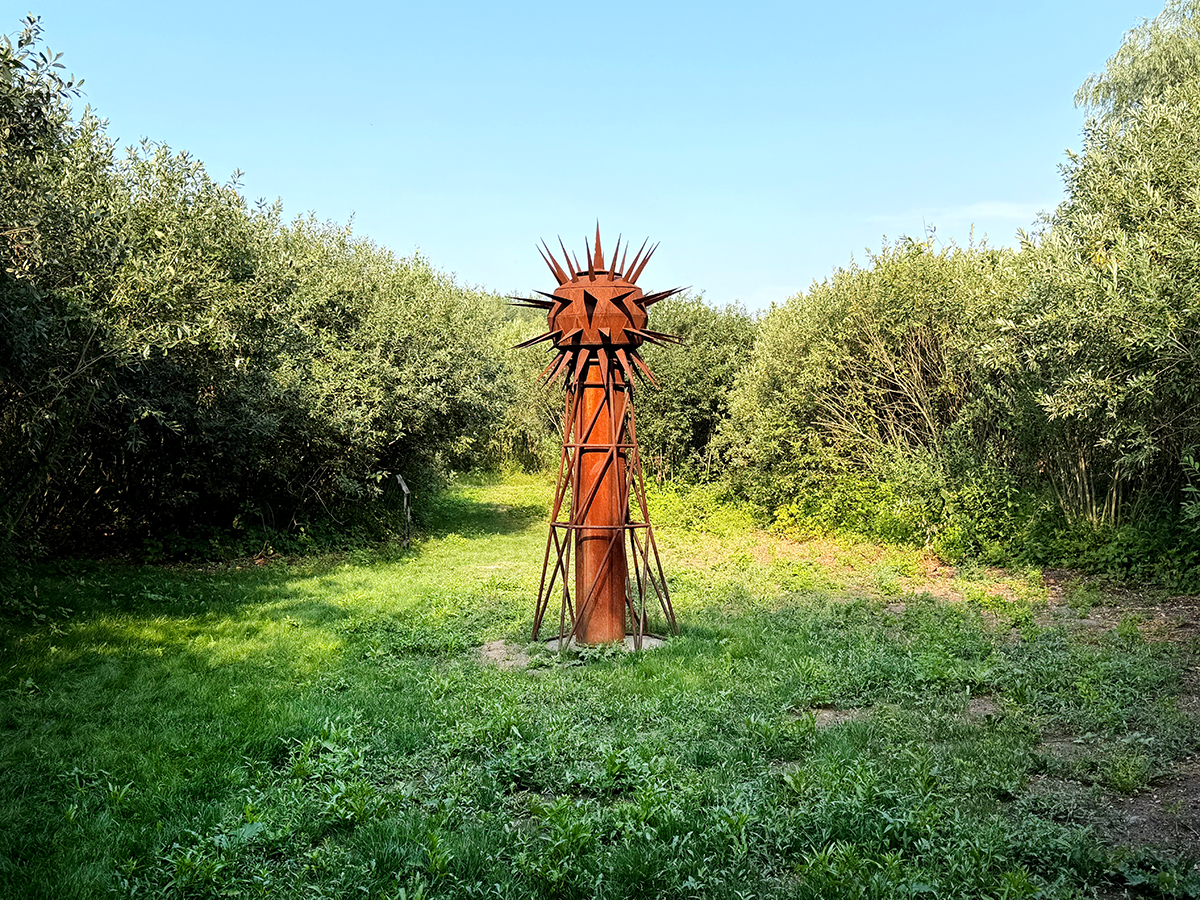
This work is a product of collective efforts, created in collaboration with Mykola Matsenko and with assistance from Roman Minin, for their group show Raimuzei Paradise Museum (2017).
It was the third year of Russia’s invasion of Ukraine, two regions in its east had become self-proclaimed independent republics, Crimea was under occupation… Addressing the image of a mace-shaped palm, Oleg Tistol says: “I have long wanted to create my own vision of this ‘paradisaical symbol’ that would take into account the realities of our life since the beginning of the war in 2014. In essence, we think of Crimea as no less than the ‘lost paradise’ that needs rescuing.
The metal sculpture brings together two semantically different forms: the heavy ‘head’ of an ancient weapon (mace) and the tree of paradise (palms). This unexpected symbiosis combines important Ukrainian and universal symbols and beliefs: the main Cossack treasure and the official symbol of power in Ukraine is united with the tree that symbolizes victory, triumph and peace. There is a saying in Ukrainian that goes ‘to hand over the palm of victory’… In Ancient Greece, winners of the Olympic Games were awarded a palm branch. In many cultures, it symbolizes resilience and immortality. Therefore, Mace Palm is an uncompromising object made of the so-called black metal, completely unadorned, devoid even of a polish or a coat of paint on the surface. It appears as an unexpected embodiment of important meanings, mergining power, bathos and national dignity with a pinch of humor, self-irony and bitter losses. It also signfies self-sufficiency and confidence, the unbreakable national spirit and its vibrant creative nature.
It might be worth it to install ‘the palm’ in an electronic warfare system and place it all along the border with Russia so that it would please the eye of Ukrainians and intimidate the enemy!”